

Showing posts with label BI. Show all posts
Showing posts with label BI. Show all posts
Thursday, 16 June 2016
Opportunities @Wipro - Freshers & experience - 2016


Monday, 13 June 2016
Opportunities - L & T Infotech

Experience
required for the Job: 3 - 6
years
Annual
Salary of the Job: 0.0
- 8.0 Lacs
Job
Location: Mumbai
(All Areas)
Dear Candidate,
Greetings from L&T
InfoTech!!
Find below details for face to face interview on Saturday 18th June, 2016.
Please confirm your availability by replying to this email with your updated CV.
(If you have been interviewed by us in last 3 months, please ignore this email)
Interview Location: Powai, Mumbai
Exp Level: 3 to 6 years.
Interview Timings: 09:00 AM To 01:00 PM
Responsibilities:-
1. Develop code from technical specifications received from the Team Lead Create sturdy reusable solution framework Expertise in technologies JAVA,J2EE, JSF, Jasper Report, SPRING, XML, PLSQL Stored Procedure, Oracle.
2. Good communication skills Oral & written Excellent Analytical Skills Good Team Player Self Driven and Motivated Knowledge of doing Estimations .
Mandatory Skills :-JAVA J2EE PLSQL Stored Procedure, Oracle Good to have skills XML, Spring, JSF
NOTE:-If you are not having experience in mandatory skills please ignore this mail and kindly forward with your friends.
NOTE:-Candidate having Notice Period more than 30 days, kindly ignore this mail.
If interested, send across your updated CV @ Nisha.Bhandari@lntinfotech.com along with following details.
Total Experience:
Relevant Experience:
Current Organization:
Current CTC:
Expected CTC:
Notice Period:
We will get back to regarding the venue details.
Find below details for face to face interview on Saturday 18th June, 2016.
Please confirm your availability by replying to this email with your updated CV.
(If you have been interviewed by us in last 3 months, please ignore this email)
Interview Location: Powai, Mumbai
Exp Level: 3 to 6 years.
Interview Timings: 09:00 AM To 01:00 PM
Responsibilities:-
1. Develop code from technical specifications received from the Team Lead Create sturdy reusable solution framework Expertise in technologies JAVA,J2EE, JSF, Jasper Report, SPRING, XML, PLSQL Stored Procedure, Oracle.
2. Good communication skills Oral & written Excellent Analytical Skills Good Team Player Self Driven and Motivated Knowledge of doing Estimations .
Mandatory Skills :-JAVA J2EE PLSQL Stored Procedure, Oracle Good to have skills XML, Spring, JSF
NOTE:-If you are not having experience in mandatory skills please ignore this mail and kindly forward with your friends.
NOTE:-Candidate having Notice Period more than 30 days, kindly ignore this mail.
If interested, send across your updated CV @ Nisha.Bhandari@lntinfotech.com along with following details.
Total Experience:
Relevant Experience:
Current Organization:
Current CTC:
Expected CTC:
Notice Period:
We will get back to regarding the venue details.
Sunday, 17 January 2016
Answers:Need suggestions - Informatica mapping to find department-wise top two salary without using rank transformation.
Hello readers,
Need your answers on this scenario.this question is asked in Accenture technical interview .
Need your answers on this scenario.this question is asked in Accenture technical interview .
Monday, 1 June 2015
Business Intelligence (BI)
What is Business Intelligence (BI)?
- Business Intelligence is a generalized term applied to a broad category of applications and technologies for gathering, storing, analyzing and providing access to data to help enterprise users make better business decisions
- Business Intelligence applications include the activities of decision support systems, query and reporting, online analytical processing (OLAP), statistical analysis, forecasting, and data mining
- An alternative way of describing BI is: the technology required to turn raw data into information to support decision-making within corporations and business processes
 |
| BusinessIntelligence Architecture |
Business
intelligence has become a critical element of information technology. It’s an
old term with general or even ambiguous meaning. It has been used synonymously
with decision support, analysis, and data warehousing, but today business
intelligence has a more specific definition and a better understood
application. Taken literally, business intelligence is just that—intelligence
or understanding of your business. You get that understanding by analyzing your
business operations.
This
business intelligence process can deliver significant, bottom-line results.
Implementing its technologies and applying its process can help make your
business more effective and more efficient, increasing revenue, decreasing
costs, and improving your relationships with customers and suppliers.
Why
BI?
- BI technologies help bring decision-makers the data in a form they can quickly digest and apply to their decision making.
- BI turns data into information for managers and executives and in general, people making decisions in a company.
- Companies want to use technology tactically to make their operations more effective and more efficient - Business intelligence can be the catalyst for that efficiency and effectiveness.
As such, none of the
above described information can be used in its raw form by corporate management
to make decisions although the information is critical in helping
make those business decisions.Therein lies the necessity for
Business Intelligence. BI technologies help bring decision-makers the data in a
form they can quickly digest and apply to their decision making. BI turns data
into information for managers and executives and in general, people making
decisions in a company.
Benefits:
The benefits of a well-planned BI implementation are going to be closely
tied to the business objectives driving the project.
- Identify trends and anomalies in business operations more quickly, allowing for more accurate and timelier decisions.
- Deliver actionable insight and information to the right place with less effort .
- Identify and operate based on a single version of the truth, allowing all analysis to be completed on a core foundation with confidence.
Facebook Commentbox
Wednesday, 20 May 2015
Data Profiling in Datawarehouse
Data
Profiling
A process
whereby one examines the data available in an existing database and collects
statistics and information about that data. The purpose of these statistics may
be to:
- Find out whether existing data can easily be used for other purposes
- Give metrics on data quality including whether the data conforms to company standards
- Assess the risk involved in integrating data for new applications, including the challenges of joins
- Track data quality
- Assess whether metadata accurately describes the actual values in the source database
- Understanding data challenges early in any data intensive project, so that late project surprises are avoided. Finding data problems late in the project can incur time delays and project cost overruns.
Data
Profiling categories :
The overall
process is in three steps, which must be executed in order:
- Column Profiling Column profiling provides critical metadata which is required in order to perform dependency profiling, and as such, must be executed before dependency profiling.
- Dependency Profiling, which identifies intra-table dependencies. Dependency profiling is related to the normalization of a data source, and addresses whether or not there are non-key attributes that determine or are dependent on other non-key attributes. The existence of transitive dependencies here may be evidence of second-normal form.
- Redundancy Profiling, which identifies overlapping values between tables. This is typically used to identify candidate foreign keys within tables, to validate attributes that should be foreign keys (but that may not have constraints to enforce integrity), and to identify other areas of data redundancy. Example: redundancy analysis could provide the analyst with the fact that the ZIP field in table A contained the same values as the ZIP_CODE field in table B, 80% of the time.
Benefits of Data Profiling:
- The benefits of data profiling is to improve data quality, shorten the implementation cycle of major projects, and improve understanding of data for the users.
- Discovering business knowledge embedded in data itself is one of the significant benefits derived from data profiling..
- Data profiling is one of the most effective technologies for improving data accuracy in corporate databases.
- Although data profiling is effective, it can be challenging not slip into analysis paralysis.
 |
| Data Profiling |
Wednesday, 8 April 2015
What is metadata (Data about data)
Meta Data
The ETL
metadata functional element is responsible for maintaining information
(metadata) about the movement and transformation of data, and the operation of
the data warehouse. It also documents the data mappings used during the
transformations. Meta data logging provides possibilities for automated
administration, trend prediction, and code reuse.
 |
| Metadata |
Meta
data examples:
Examples of
data warehouse metadata that can be recorded and used to analyze the activity
and performance of a data warehouse include:
o
Data Lineage,
such as the time that a particular set of records was loaded into the data
warehouse.
o
Schema Changes,
such as changes to table definitions.
o
Data Type Usage, such as identifying all tables that use the "Birthdate"
user-defined data type.
o
Transformation Statistics, such as the execution time of each stage of a transformation, the
number of rows processed by the transformation, the last time the
transformation was executed, and so on.
o
DTS Package Versioning, which can be used to view, branch, or retrieve any historical version
of a particular DTS package.
o
Data Warehouse Usage Statistics, such as query times for reports.
Business
Metadata:
In IT, Business Metadata is about creating
definitions, business rules. The advantage is of this business metadata is
whether they are technical or non-technical, everybody would understand what is
going on within the organization. Example:
 |
| Business Metadata |
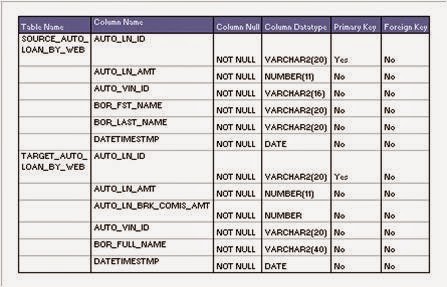
Technical
Metadata:
Technical metadata describes information about
technology such as the ownership of the database, physical characteristics of a
database. In Technical metadata, derivation rules are important when formulae
or calculations are applied on a column. Example:
 |
| Technical Metadata |
Facebook Commentbox
Thursday, 12 March 2015
What is ETL (Extract, Transform, Load)
ETL refers to the methods
involved in accessing and manipulating
source data and loading it into target
database. During the ETL process, more often,
data is extracted from an OLTP database, transformed to match the data warehouse schema, and loaded into the data warehouse
database.
(Extract, Transform, Load)
–
 |
| ETL Process |
EXTRACTION :
- Data Capturing: The ETL extraction element is responsible for extracting data from the source system. During extraction, data may be removed from the source system or a copy made and the original data retained in the source system.
 |
| Data Capturing |
- Data Transmission: Legacy systems may require too much effort to implement such offload processes, so legacy data is often copied into the data warehouse, leaving the original data in place. Extracted data is loaded into the data warehouse staging area (a relational database usually separate from the data warehouse database), for manipulation by the remaining ETL processes.
 |
| Data Transmission |
- Cleansing Process:
- Data extraction is generally performed within the source system itself.
- Data extraction processes can be implemented using Transact-SQL stored procedures, Data Transformation Services (DTS) tasks, or custom applications developed in programming or scripting languages.

Transformation:
The ETL
transformation element is responsible for data validation, data accuracy, data
type conversion, and business rule application. An ETL system that uses inline
transformations during extraction is less robust and flexible than one that
confines transformations to the reformatting element. Transformations performed
in the OLTP system impose a performance burden on the OLTP database.
- Data Validation: Check that all rows in the fact table match rows in dimension tables to enforce data integrity.
- DataAccuracy : Ensure that fields contain appropriate values, such as only "off" or "on" in a status field.
- Data Type Conversion : Ensure that all values for a specified field are stored the same way in the data warehouse regardless of how they were stored in the source system. For example, if one source system stores "off" or "on" in its status field and another source system stores "0" or "1" in its status field, then a data type conversion transformation converts the content of one or both of the fields to a specified common value such as "off" or "on".
- Business Rule Application: Ensure that the rules of the business are enforced on the data stored in the warehouse. For example, check that all customer records contain values for both FirstName and LastName fields.
 |
| Transformation |
Loading :
- The ETL loading element is responsible for loading transformed data into the data warehouse database.
- Data warehouses are usually updated periodically rather than continuously, and large numbers of records are often loaded to multiple tables in a single data load.
- The data warehouse is often taken offline during update operations so that data can be loaded faster and SQL Server 2000 Analysis Services can update OLAP cubes to incorporate the new data. BULK INSERT, bcp, and the Bulk Copy API are the best tools for data loading operations.
- The design of the loading element should focus on efficiency and performance to minimize the data warehouse offline time.
Facebook Commentbox
Thursday, 5 March 2015
Logical Design In Datawearhouse
Logical Data Model (LDM) -
- A logical design is conceptual and abstract. The process of logical design involves arranging data into a series of logical relationships called entities and attributes.
- Logical data model includes all required entities, attributes, key groups, and relationships that represent business information and define business rules.
- An entity represents a chunk of information. In relational databases, an entity often maps to a table. An attribute is a component of an entity and helps define the uniqueness of the entity. In relational databases, an attribute maps to a column.
 |
| Logical design in Data wearhouse |
Important Terms:

Entity
- Entity: Are the principal data object about which
information is to be collected. A class of persons, places, objects, events, or
concepts about which we need to capture and store data.
- Persons: agency, contractor, customer, department, division, employee, instructor, student, supplier.
- Places: sales region, building, room, branch office, campus.
- Objects: book, machine, part, product,
raw material, software license, software package, tool, vehicle model, vehicle.
- Events: application, award,
cancellation, class, flight, invoice, order, registration, renewal,
requisition, reservation, sale, trip.
- Concepts: account, block of time, bond,
course, fund, qualification, stock.
- Relationship:A natural business association that exists between one or more entities.
The relationship may represent an event that links the entities or merely a
logical affinity that exists between the entities

Relationship
An example of a relationship would be:
- Employees are
assigned to projects.
- Student
enrolling in a curriculum.
- Projects have
subtasks.
- Departments
manage one or more projects
- Cardinality:The cardinality of a relationship is the actual
number of related occurrences for each of the two entities. The basic types of
connectivity for relations are: one-to-one, one-to-many, and many-to-many. The
minimum and maximum number of occurrences of one entity that may be related to
a single occurrence of the other entity. Because all relationships are
bidirectional, cardinality must be defined in both directions for every
relationship.

Cardinality
- Cardinality Notations:

Facebook Commentbox
Tuesday, 24 February 2015
Data Warehouse Design Approaches
There are two major types of approaches to building or designing the Data Warehouse.
- The Top-Down Approach
- The Bottom-Up Approach
s The Top Down Approach:
- The data flow in the top down OLAP environment begins with data extraction from the operational data sources. This data is loaded into the staging area and validated and consolidated for ensuring a level of accuracy and then transferred to the Operational Data Store (ODS).
- Detailed data is regularly extracted from the ODS and temporarily hosted in the staging area for aggregation, summarization and then extracted and loaded into the Data warehouse.
- Once the Data warehouse aggregation and summarization processes are complete, the data mart refresh cycles will extract the data from the Data warehouse into the staging area and perform a new set of transformations on them. This will help organize the data in particular structures required by data marts. Then the data marts can be loaded with the data and the OLAP environment becomes available to the users
 |
| DWH TOP DOWN DESIGN APPROACH |
- The data marts are treated as sub sets of the data warehouse. Each data mart is built for an individual department and is optimized for analysis needs of the particular department for which it is created.
The
Bottom-Up Approach:
- Ralph Kimball designed the data warehouse with the data marts connected to it with a bus structure.
- The bus structure contained all the common elements that are used by data marts such as conformed dimensions, measures etc defined for the enterprise as a whole.
- This architecture makes the data warehouse more of a virtual reality than a physical reality
- All data marts could be located in one server or could be located on different servers across the enterprise while the data warehouse would be a virtual entity being nothing more than a sum total of all the data marts
- In this context even the cubes constructed by using OLAP tools could be considered as data marts.
 |
| Kimball Approach |
•
The bottom-up approach reverses the positions
of the Data warehouse and the Data
marts. Data marts are directly loaded with the data from the operational systems through the staging area.
•
The
data flow in the bottom up approach starts with extraction of data from operational databases into the
staging area where it is processed and
consolidated and then loaded into the ODS.
•
The
data in the ODS is appended to or replaced by the fresh data being loaded.
After the ODS is refreshed the current data is once again extracted into the
staging area and processed to fit into the Data mart structure. The data from the Data Mart, then is
extracted to the staging area aggregated, summarized and so on and loaded into
the Data Warehouse and made available to the end user for analysis.
Facebook Commentbox
Friday, 30 January 2015
SQL interview Questions and answers for Freshers
 |
| SQl Interview Qustions For Fresher's |
1. What is the difference between a
"where" clause and a "having" clause?
- "Where" is a kind of restiriction statement. You use where
clause to restrict all the data from DB.Where clause is using before result
retrieving. But Having clause is using after retrieving the data.Having clause
is a kind of filtering command.
2. What is the basic form of a SQL
statement to read data out of a table?
-The basic form to
read data out of table is ‘SELECT * FROM table_name; ‘ An answer: ‘SELECT *
FROM table_name WHERE xyz= ‘whatever’;’ cannot be called basic form because of
WHERE clause.
3. What structure can you implement for
the database to speed up table reads?
- Follow the rules of DB tuning we have
to: 1] properly use indexes ( different types of indexes) 2] properly locate
different DB objects across different tablespaces, files and so on.3] create a
special space (tablespace) to locate some of the data with special datatype (
for example CLOB, LOB and …)
4. What are the tradeoffs with having
indexes?
- 1. Faster selects, slower updates.
2. Extra storage space to store
indexes. Updates are slower because in addition to updating the table you have
to update the index.
5. What is a "join"?
- ‘join’ used to
connect two or more tables logically with or without common field.
6. What is "normalization"?
"Denormalization"? Why do you sometimes want to denormalize?
- Normalizing data means eliminating redundant information from a table
and organizing the data so that future changes to the table are easier.
Denormalization means allowing redundancy in a table. The main benefit of
denormalization is improved performance with simplified data retrieval and
manipulation. This is done by reduction in the number of joins needed for data
processing.
7. What is a "constraint"?
- A constraint allows you to apply simple referential integrity checks
to a table. There are four primary types of constraints that are currently
supported by SQL Server: PRIMARY/UNIQUE - enforces uniqueness of a particular
table column. DEFAULT - specifies a default value for a column in case an
insert operation does not provide one. FOREIGN KEY - validates that every value
in a column exists in a column of another table. CHECK - checks that every
value stored in a column is in some specified list. Each type of constraint
performs a specific type of action. Default is not a constraint. NOT NULL is
one more constraint which does not allow values in the specific column to be
null. And also it the only constraint which is not a table level constraint.
8. What types of index data structures can
you have?
- An index helps to faster search values in tables. The three most
commonly used index-types are: - B-Tree: builds a tree of possible values with
a list of row IDs that have the leaf value. Needs a lot of space and is the
default index type for most databases. - Bitmap: string of bits for each
possible value of the column. Each bit string has one bit for each row. Needs
only few space and is very fast.(however, domain of value cannot be large, e.g.
SEX(m,f); degree(BS,MS,PHD) - Hash: A hashing algorithm is used to assign a set
of characters to represent a text string such as a composite of keys or partial
keys, and compresses the underlying data. Takes longer to build and is
supported by relatively few databases.
9. What is a "primary key"?
- A PRIMARY INDEX or PRIMARY KEY is something which comes mainly from database theory. From its behavior is almost the same as an UNIQUE INDEX, i.e.
there may only be one of each value in this column. If you call such an INDEX
PRIMARY instead of UNIQUE, you say something about
your table design, which I am not able to explain in few words. Primary Key is a type of a constraint enforcing uniqueness and data integrity for each row of a table. All columns participating in a primary key constraint must possess the NOT NULL property.
your table design, which I am not able to explain in few words. Primary Key is a type of a constraint enforcing uniqueness and data integrity for each row of a table. All columns participating in a primary key constraint must possess the NOT NULL property.
10.What is a "functional
dependency"? How does it relate to database table design?
- Functional
dependency relates to how one object depends upon the other in the database.
for example, procedure/function sp2 may be called by procedure sp1. Then we say
that sp1 has functional dependency on sp2.
11.What is a "trigger"?
- Triggers are stored
procedures created in order to enforce integrity rules in a database. A trigger
is executed every time a data-modification operation occurs (i.e., insert,
update or delete). Triggers are executed automatically on occurance of one of
the data-modification operations. A trigger is a database object directly
associated with a particular table. It fires whenever a specific statement/type
of statement is issued against that table. The types of statements are
insert,update,delete and query statements. Basically, trigger is a set of SQL
statements A trigger is a solution to the restrictions of a constraint. For
instance: 1.A database column cannot carry PSEUDO columns as criteria where a
trigger can. 2. A database constraint cannot refer old and new values for a row
where a trigger can.
12.Why can a "group by" or
"order by" clause be expensive to process?
- Processing of
"group by" or "order by" clause often requires creation of
Temporary tables to process the results of the query. Which depending of the
result set can be very expensive.
13.What is "index covering" of a
query?
- Index covering means that "Data can be found only using
indexes, without touching the tables"
14.What is a SQL view?
- An output of a
query can be stored as a view. View acts like small table which meets our
criterion. View is a precomplied SQL query which is used to select data from
one or more tables. A view is like a table but it doesn’t physically take any
space. View is a good way to present data in a particular format if you use
that query quite often. View can also be used to restrict users from accessing
the tables directly.
Thank you Readers.If you have more Question or suggestions for Sql Interview Qustions for freshers then please comment on below box.
Facebook Commentbox
Subscribe to:
Posts (Atom)

 Subscribe to our mailing list to get the updates to your email inbox... We can't wait more to have your email in our subscribers email list. Just put your nice email in below box: